

Posted on
Garden Furniture
How Aluminium Came to Dominate Garden Furniture
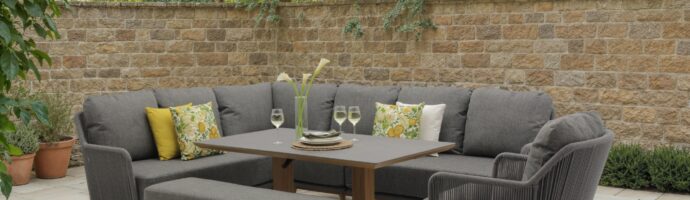

The modern garden would be almost unrecognisable to someone living a century ago.
Today, we often treat the garden as another room. We eat outside, entertain friends around dining tables and spend summer afternoons relaxing on outdoor sofas. Casual dining sets allow the same space to be used for eating and lounging, while an aluminium pergola can provide a more sheltered area for outdoor kitchens, televisions and even hot tubs.
As our gardens have changed, so has the furniture we put in them.
Timber, iron, steel, plastic and synthetic rattan have all had important periods of popularity. Today, however, aluminium has become one of the most widely used materials in better-quality garden furniture.
So why has aluminium become so important, and what did people have in their gardens before it?
Why aluminium works so well outdoors
The greatest advantage of aluminium is its practicality.
It is relatively lightweight, durable and does not rust in the same way as iron or ordinary steel. A substantial dining chair can still be moved around a patio without too much effort, while a properly finished aluminium frame requires comparatively little routine maintenance.
Aluminium is also extremely versatile. It can be used to create dining tables, chairs, loungers, modular sofas, storage boxes and pergolas. It works equally well in a traditional garden or a much more contemporary outdoor space.
This versatility can be seen across today’s aluminium garden furniture, where the same underlying material is used to create everything from compact bistro sets to large corner sofas and eight-seat dining tables.
That does not mean all aluminium garden furniture is made to the same standard.
Why the quality of aluminium furniture matters
The word “aluminium” on a product description does not, by itself, guarantee that the furniture will last.
Cheaper furniture may use thinner sections, weaker joints, poorly finished welds or lower-quality fixings. The frame can begin to flex, chairs may become unstable and tables can start to wobble. Welded joints are particularly vulnerable if they have not been formed properly or if the furniture is frequently moved across uneven ground.
The protective finish matters too. Aluminium garden furniture is commonly powder coated, but the metal must be cleaned and prepared correctly before that coating is applied. If the preparation is poor, the surface may eventually bubble, peel or lift.
Once that happens, the furniture can begin to look tired surprisingly quickly. Exposed aluminium will not develop the red rust associated with iron, but it can oxidise, become marked and lose the clean appearance it had when new.
The smaller components must also be considered. Bolts, screws, brackets, adjustable feet and moving mechanisms can all shorten the useful life of a set if they are cheaply made.
From our experience of seeing older furniture that customers are replacing, the most common problems with lower-quality aluminium furniture are:
- frames beginning to bend or flex;
- cracked or untidy welded joints;
- loose fixings and unstable legs;
- powder coating that bubbles or peels;
- rusting screws or internal components;
- worn fabric and cushions that cannot easily be replaced.
Better furniture begins with a stronger and more carefully constructed frame. The preparation beneath the coating, the consistency of the welding and the quality of the fittings all affect how well the furniture performs after several years outdoors.
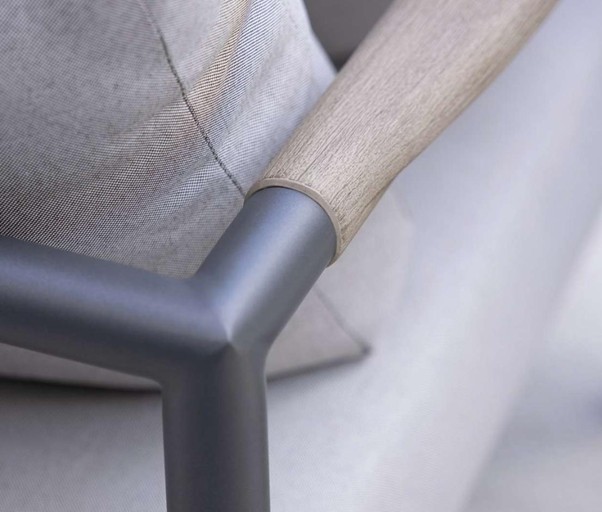
Modern aluminium furniture combines carefully finished structural frames with warmer materials, fabrics and detailing.
Aluminium is not necessarily more durable than every alternative. Good-quality teak, for example, can last for decades. The attraction of aluminium is that it combines durability with relatively low weight, low maintenance and the clean appearance many homeowners now want.
Aluminium is often the hidden structure
We may be living in the age of aluminium garden furniture, but the aluminium itself is not always immediately visible.
It frequently forms the supporting frame beneath synthetic rattan, outdoor rope, textilene or weather-resistant fabric. It can also be combined with ceramic, glass, teak or wood-effect tabletops.
This combination has allowed outdoor furniture to look and feel increasingly like furniture designed for inside the home. The aluminium provides the structure, while the weave, upholstery and cushions provide comfort and character.
That development owes a great deal to one of the biggest changes in recent garden-furniture history: synthetic rattan.
How synthetic rattan changed garden furniture
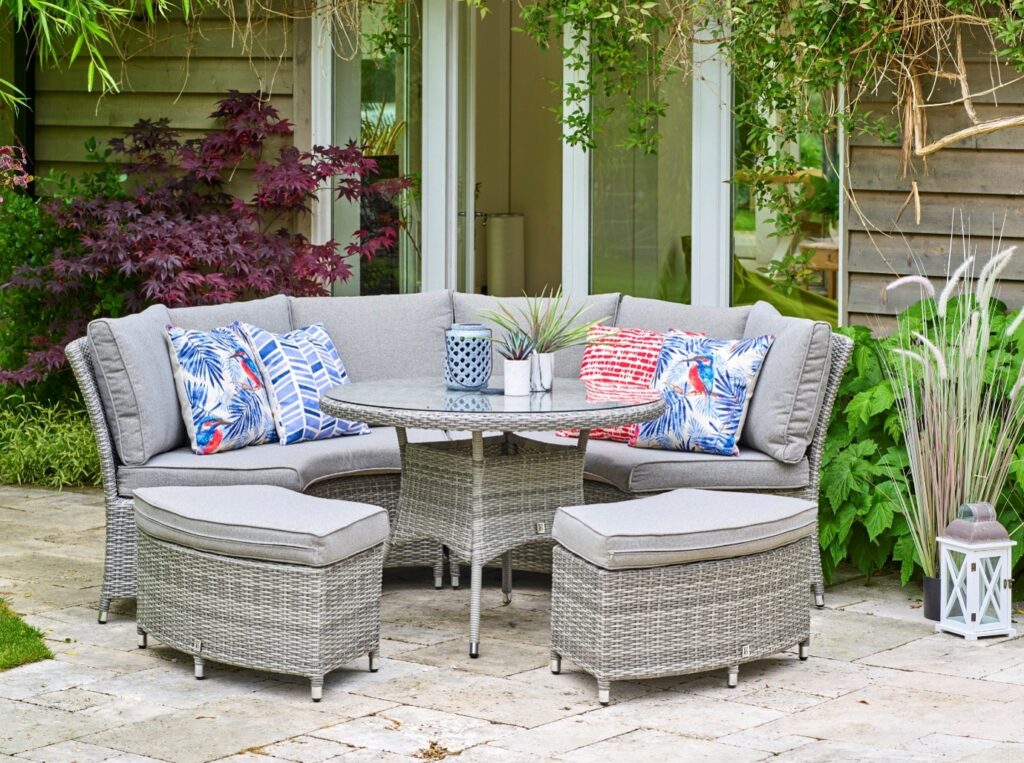
The Leisuregrow collection demonstrates how aluminium can create substantial furniture without the weight and maintenance associated with traditional iron or steel. Note the synthetic rattan effect. This is the Monaco Curved Modular Rattan Dining set
Natural rattan comes from climbing palms found principally in tropical parts of Asia. It is strong, flexible and attractive, which made it popular for conservatory furniture and occasional seating.
Its weakness is prolonged exposure to outdoor conditions. Repeated rain, damp, frost and strong sunlight can cause natural fibres to fade, split, distort or deteriorate. Natural rattan is therefore generally better suited to indoor or well-sheltered areas than to an exposed British patio.
Synthetic rattan changed that.
Usually made from polyethylene or a similar man-made resin, synthetic rattan could be woven around a metal frame to reproduce the character of natural rattan while providing much greater resistance to outdoor conditions.
Better-quality synthetic rattan is generally UV stabilised and woven over a powder-coated aluminium frame. Less expensive furniture may use a lower-grade plastic weave or a steel frame, creating a greater risk of fading, splitting or rust developing beneath the material.
The change was about much more than weather resistance.
Synthetic rattan allowed outdoor seating to stop looking like a park bench or a collection of temporary chairs. Manufacturers could produce deep sofas, corner arrangements, armchairs, daybeds and large dining groups that would not have looked entirely out of place inside the home.
It arrived at the right moment. Gardens were increasingly being used for entertaining rather than gardening alone. Homeowners wanted somewhere comfortable to sit with friends, eat outside and enjoy longer summer evenings.
Modern rattan patio sets continue that development, although the best examples often rely on aluminium beneath the weave.
Synthetic rattan helped turn the patio into an outdoor living room.
Before synthetic rattan came the plastic-furniture era
Anyone of a certain age will remember the white or dark-green plastic chairs that appeared in gardens throughout the 1980s and 1990s.
They were lightweight, inexpensive, weather resistant and easily stacked. For many households, moulded plastic made owning a complete set of garden furniture affordable for the first time.
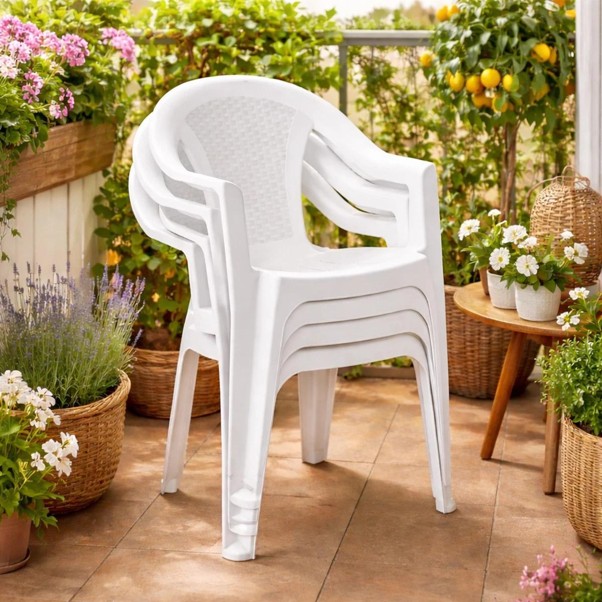
Stackable moulded-plastic chairs became a familiar sight in British gardens during the 1980s and 1990s.
The development of plastic furniture had begun decades earlier.
During the 1950s and 1960s, designers explored ways of moulding chairs from plastic in shapes that would have been difficult or expensive to produce in timber or metal. Important designs included Verner Panton’s Panton Chair, Helmut Bätzner’s Bofinger Chair and Vico Magistretti’s Selene.
These pieces demonstrated that plastic furniture could be both practical and genuinely innovative. However, they were designer products rather than the inexpensive garden chairs that would later appear in millions of homes.
The major breakthrough for the mass market came in 1972, when French engineer Henry Massonnet developed the Fauteuil 300.
The chair could be moulded from polypropylene in a single production process. It was lightweight, stackable and exceptionally quick to manufacture. Massonnet reduced the production cycle to less than two minutes, making the design much easier and cheaper to produce in large quantities.
From the 1980s onwards, increasing numbers of manufacturers introduced their own versions. By the 1990s, the one-piece plastic chair—or monobloc—had become a familiar sight in gardens, pavement cafés, holiday resorts, campsites and beside swimming pools.
Plastic made garden furniture accessible
Plastic garden furniture ranged from recognised pieces of industrial design to some of the cheapest chairs and tables available at the local garden centre.
Its great achievement was accessibility.
Timber and metal furniture could be expensive, heavy and difficult to store. Plastic put outdoor tables, chairs and loungers within the reach of far more households.
It also established expectations that remain with us today. People wanted garden furniture that was:
- affordable;
- easy to clean;
- resistant to rain;
- lightweight enough to move;
- stackable or easy to store;
- available in complete matching sets.
However, plastic’s greatest advantage gradually became its weakness.
As moulded furniture became cheaper and more widespread, it also began to feel disposable. Chairs faded, discoloured, became brittle or cracked. Once damaged, they were difficult to repair and often inexpensive enough simply to replace.
The familiar white monobloc chair gradually acquired a reputation for looking cheap, while concerns about disposable plastic and unnecessary waste became harder to ignore.
Plastic furniture did not disappear. Contemporary designers still use polypropylene, polycarbonate and other plastics to create high-quality indoor and outdoor chairs. Philippe Starck’s transparent Louis Ghost Chair is one well-known example of plastic being used to produce something elegant and weather resistant.
What declined was the dominance of the inexpensive moulded-plastic patio set.
By the early years of the twenty-first century, synthetic rattan offered something warmer, more substantial and more comfortable. Plastic had made garden furniture accessible; synthetic rattan helped make it homely.
Before plastic: the age of wood and metal
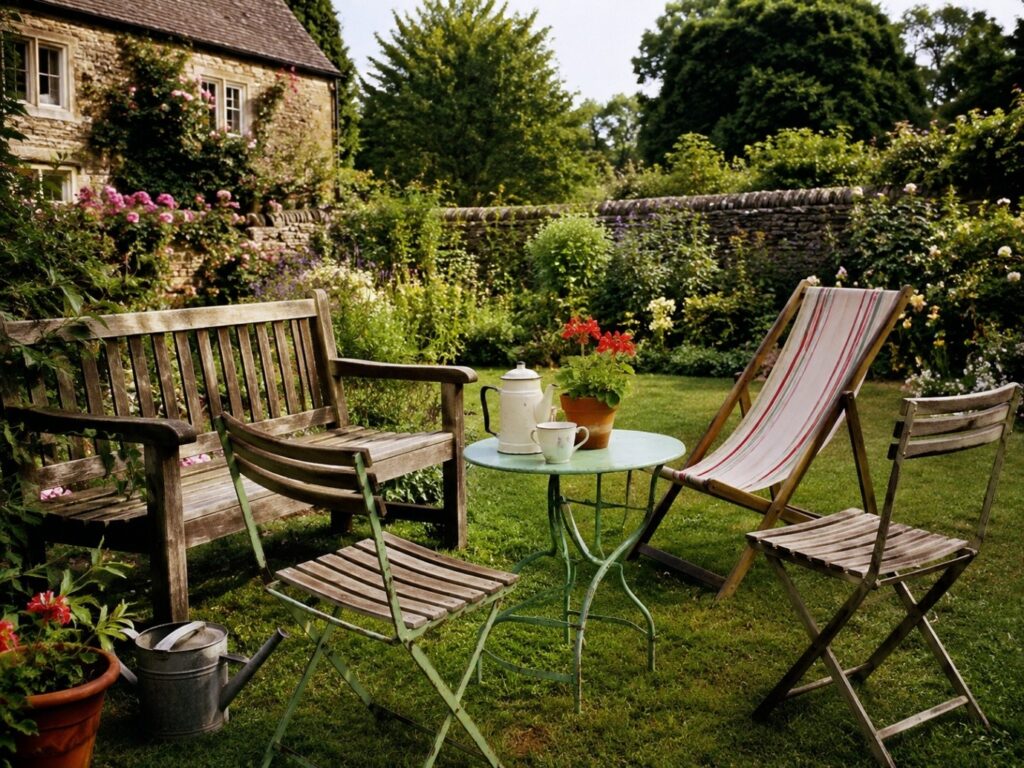
Before inexpensive plastic furniture became widely available, there was no single material that dominated every British garden. Many gardens contained a mixture of benches, deckchairs and folding seats.
Garden furniture was also more likely to be accumulated piece by piece. A household might have a permanent wooden bench, several folding chairs, a deckchair and perhaps a small painted metal table.
The large, coordinated outdoor dining and lounge collections we recognise today were far less common.
The wooden garden bench
The wooden bench was one of the most familiar forms of outdoor seating.
It could be positioned beneath a tree, against a wall or at the end of a garden. Simple softwood benches were widely available, while better-quality hardwood furniture offered greater durability.
Teak became particularly important at the premium end of the market. It is dense, naturally oily and capable of withstanding outdoor exposure extremely well. Good teak furniture can last for many years, although it is heavy and considerably more expensive than mass-produced plastic.
Timber also changes in appearance as it weathers. Some people appreciate the silver-grey finish that teak develops naturally, while others prefer to clean and treat it to retain more of its original colour.
Less durable timber requires more protection. Without suitable treatment and sensible positioning, it may absorb moisture, warp, split or eventually rot.
Deckchairs and folding seats
For many households, relaxing outside meant bringing a deckchair out of the shed rather than leaving a sofa permanently on the patio.
The traditional deckchair used a folding wooden frame with a length of canvas stretched between it. It was simple, portable and easy to store when the weather changed.
During the post-war period, tubular-metal chairs also became familiar in British gardens. They often had brightly patterned fabric or vinyl seats and could be folded away after use.
These chairs did not attempt to turn the garden into a living room. They were occasional furniture: brought outside when the sun appeared and returned to the shed or garage afterwards.
Painted iron and steel
Iron and steel furniture provided another alternative.
Metal allowed manufacturers to produce slim frames, decorative shapes and durable structures. Painted steel tables and chairs appeared on patios and terraces, while heavier iron benches remained common in parks and established gardens.
However, ordinary iron and steel are vulnerable to corrosion. Scratched or neglected paint allowed moisture to reach the metal, after which rust could spread beneath the surface.
The furniture could also be heavy. That offered stability in windy conditions, but made larger pieces difficult to move and store.
Plastic succeeded not because wood and metal had failed, but because it dealt with several of their practical limitations at once. It was cheap, light, weather resistant and required little care.
The Victorian garden: cast iron and ornament
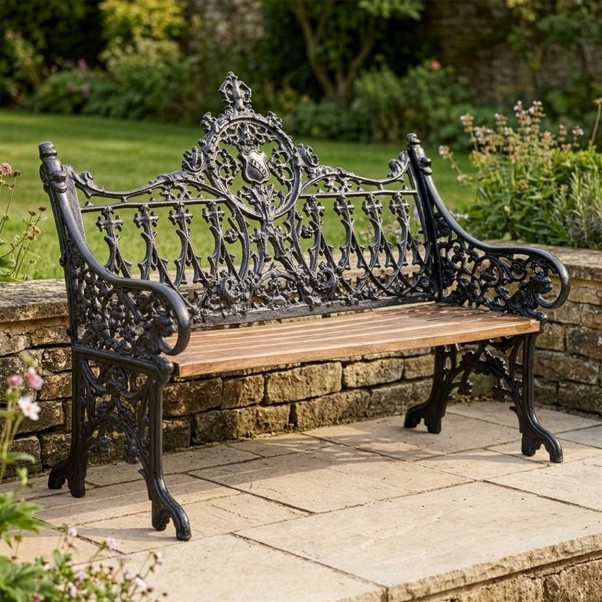
Cast iron allowed Victorian manufacturers to reproduce elaborate decorative patterns on outdoor furniture.
Going further back, Victorian gardens and public parks frequently contained decorative cast-iron benches, chairs and tables.
Cast iron suited Victorian design particularly well because molten metal could be poured into moulds to reproduce elaborate patterns. Manufacturers created furniture decorated with leaves, vines, flowers, Gothic arches and other ornamental motifs.
Industrial production made it possible to repeat these complex designs more efficiently than if each piece had been formed individually by hand.
The furniture was strong and substantial, but also extremely heavy. It needed to be painted and maintained to protect it from rust, while thin or highly decorative cast sections could crack if subjected to an impact.
Garden furniture during this period was often used differently from today. A bench might be placed beside a path, underneath a tree or at a viewpoint. It provided somewhere to sit, read, talk or admire the planting.
It was not generally the centre of a complete outdoor living arrangement. The garden remained the main attraction and the furniture supported the experience of it.
Before the Victorians: Georgian garden seats
Recognisable garden furniture existed before the Victorian period, particularly in the grounds of wealthy Georgian houses.
The eighteenth century saw major changes in British garden design. Formal layouts gradually gave way to sweeping lawns, lakes, woodland paths and carefully composed views.
Seats were positioned along walks and at selected viewpoints, allowing owners and their guests to stop and appreciate the landscape. These included stone benches, painted wooden seats, rustic chairs and movable timber furniture.
Purpose-designed garden furniture was clearly established by this time. In 1761, Thomas Chippendale produced drawings for two garden chairs and a matching long seat.
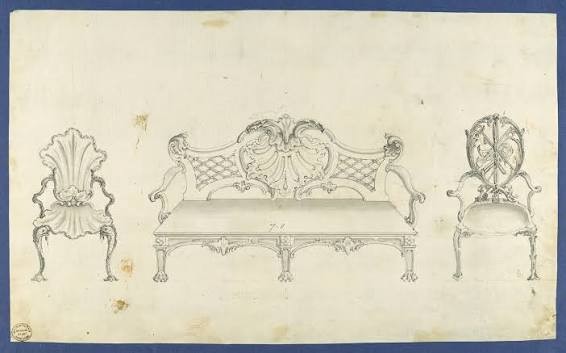
Thomas Chippendale was designing furniture specifically for gardens by the eighteenth century.
This does not mean Georgian Britain had a garden-furniture market comparable with the one we know today. Such furniture was primarily associated with large houses and wealthy estates.
Nevertheless, the basic idea was recognisable: seating was being designed specifically for the garden and positioned according to how people were expected to use the landscape.
Before movable garden furniture
In earlier formal gardens, seating was often fixed into the landscape or furniture was temporarily brought outside from the house.
Seventeenth-century gardens were used for walking, conversation, entertainment and sometimes outdoor dining. Large gardens contained terraces, straight paths, clipped hedges, fountains, pavilions and enclosed spaces.
Stone benches and simple timber seats could be incorporated into these settings, but there was not yet a mass market for coordinated outdoor furniture.
Go back further still and the distinction between furniture and garden becomes less clear.
The medieval turf bench
One of the most distinctive features of the medieval enclosed garden was the turf bench.
A low structure was built from stone, brick, timber or woven willow, filled with earth and covered with grass. Turf benches could be straight, curved or constructed around a tree. Some were positioned beneath arbours or trellises to provide shade.
They were effectively permanent garden sofas, although they were built into the garden rather than purchased as movable pieces of furniture.
Roman gardens and outdoor living
The history of people relaxing in gardens reaches back at least as far as the Romans.
Roman villas often contained enclosed courtyard or peristyle gardens with plants, fountains, pools, sculptures and shaded walkways. These spaces were used for conversation, contemplation and, in some cases, dining.
There is limited surviving evidence showing the precise furniture used in Roman Britain, so it would be wrong to describe a recognisable garden-furniture industry.
What the Romans clearly understood, however, was the appeal of using a carefully designed outdoor space as an extension of the home.
From the garden bench to the outdoor living room
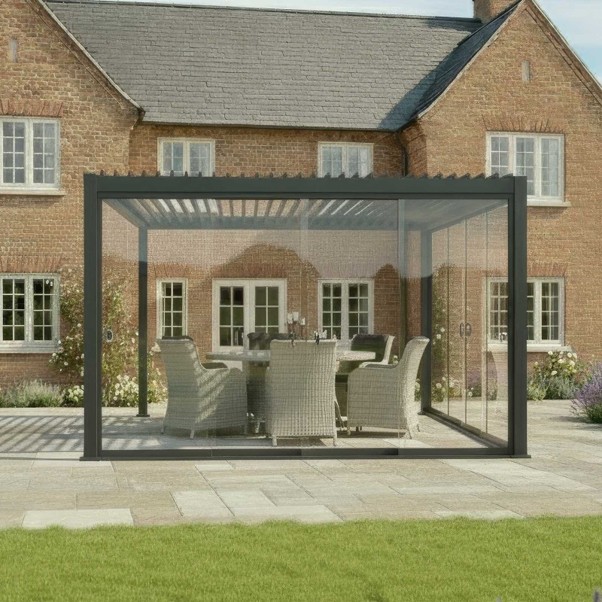
We now expect far more from our gardens, whether we are furnishing a small patio, creating a dining terrace or building a complete outdoor room beneath a pergola.
The history of garden furniture is not simply a sequence in which one material replaced another.
Each period changed what people expected from their outdoor spaces.
Medieval turf benches were built into enclosed gardens. Georgian seats allowed visitors to pause and admire carefully designed views. Victorian manufacturers made ornate outdoor furniture in greater quantities. Wooden benches, deckchairs and folding metal seats became familiar features of twentieth-century gardens.
Plastic made garden furniture affordable to almost everyone. Synthetic rattan introduced the comfort and appearance of indoor sofas. Aluminium then provided the strong, light and low-maintenance structure needed to support increasingly sophisticated designs.
Modern garden furniture brings these developments together.
We now expect it to be comfortable, attractive, weather resistant, relatively easy to move and simple to maintain. We also expect far more choice, whether we are furnishing a small balcony, a dining terrace or a complete outdoor room beneath a pergola.
Aluminium currently comes closest to meeting all these expectations in one material.
That does not mean every aluminium set is automatically a good one. The quality of the frame, welds, powder coating, fittings, fabric and cushions still determines whether the furniture will continue to look and feel good after years of use.
But when those elements are made properly, aluminium offers a combination of practicality, durability and design freedom that earlier generations of garden furniture rarely achieved.
That is why it has become the defining material of the modern garden.